OU Divergence Skew
OU Divergence detects when a DEX's price drifts away from the real market price (Binance/Bybit/Pyth oracle) and skews your orders to profit from the expected mean reversion.
Why it exists
DEX prices regularly deviate from centralized exchange prices. On thin orderbook, a large taker order, or a delayed oracle update can push the DEX price 0.1-1% above or below fair value. These deviations almost always revert causing the price to snap back toward the oracle (pyth/binance/bybit real price) within seconds to minutes.
OU Divergence measures this gap in real time and shifts your orders to capture the reversion.
How it works
The bot tracks the difference between the DEX you are trading on's mid price and the oracle price (Pyth/Binance) every cycle. It models this gap as a mean-reverting process since price deviations are temporary and pull back toward real mid price.
From the rolling history, the bot learns two things about the current market:
-
How far the DEX typically deviates — some DEX's have tight tracking (1-2bps gaps), others have wide gaps (10-30bps). The bot adapts its spread to match which can cause your spread to appear wider and non symmetrical.
-
Which direction the gap is right now: if the DEX is trading above oracle, the bot tightens asks (more likely to sell into the premium) and widens bids (less likely to buy at the inflated price). Say oracle spikes 0.5% up quickly then reverts to true price, When price snaps back down, you've sold high and captured the profit.
What it does to your orders
When the DEX is above oracle (expect price to drop):
- Ask side tightens ~5-10% per unit of deviation
- Bid side widens ~5-10% per unit of deviation
- Net effect: you sell more, buy less → when price drops back, you profit from bot closing via limit.
When the DEX is below oracle (expecting price to rise):
- Bid side tightens
- Ask side widens
- Net effect: you buy more, sell less → when price bounces, you profit on the divergence buy.
When the DEX matches oracle:
- No skew applied, orders stay symmetrical
Impact on volume
OU Divergence also widens your base spread proportional to how volatile the DEX-oracle gap is. On a stable venue with tight tracking, the widening is negligible (under 0.1%). On a thin DEX with frequent gaps, spread may widen 20-50%. It learns and adapts over time to that exact book.
This reduces your fill rate. To compensate, increase your base order size so each fill captures more profit per round trip. As OU skews the outer bands to catch wicks, it shrinks the inner orders — increasing base size keeps your volume consistent.
When to use
- Any DEX venue (Ethereal, HotStuff, Pacifica, Aftermath, etc.)
- Markets where the DEX regularly deviates from Binance/Bybit/Pyth/CEX's pricing
- Combined with any mode — works on Simple Grid, Standard, Directional, and Fast. Recommended for mode 2 with GLFT as they are complementary.
When to skip
- CEX venues (Binance, Bybit) — prices track each other closely, OU finds no edge or price deviations
- Ultra-liquid DEX pairs where the gap is consistently under 0.5bps
- If your priority is maximum fill rate over per-fill profitability
Combining with GLFT
GLFT and OU serve different purposes and work together cleanly:
- GLFT sets your spread width based on inventory risk
- OU shifts orders based on where the price is relative to fair value
GLFT's math for skewing + order placement/size answers "how wide?" while OU answers "which direction to lean." They don't conflict.
How to know if the exchange is a good fit for OU
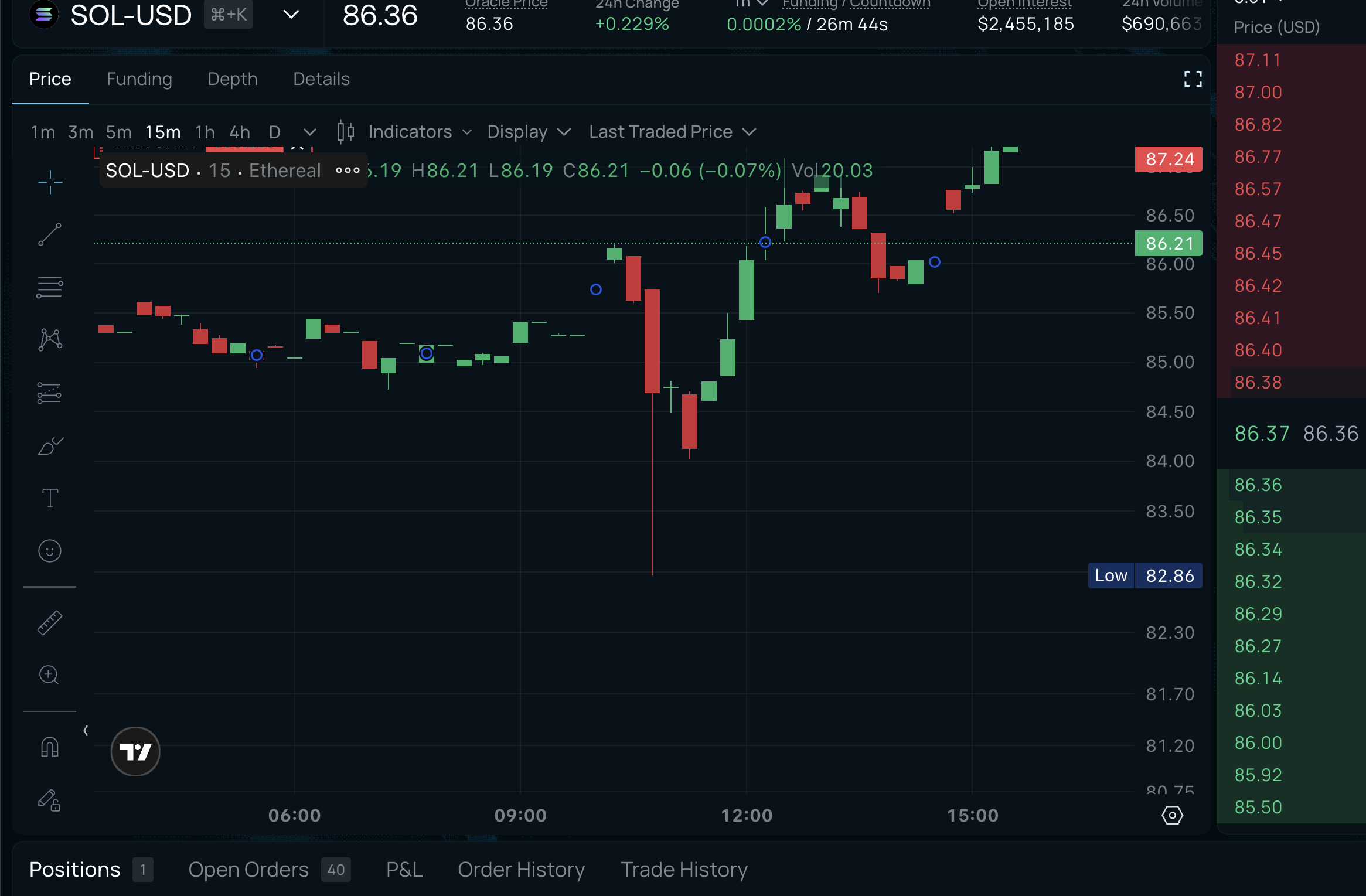
Many exchanges have an option on their chart to view "Last Trade Price." If you see LTP having spikes but switching to mark or index price shows no spikes, OU is a perfect candidate for that DEX — the spikes are divergence that OU will capture.
In the example above, SOL on Ethereal wicked to $82.86 while the oracle price stayed at $86.36. That's a 4% gap. OU would detect "DEX is far below oracle" → tighten bids to buy the dip → price snaps back to $86 → the bot sells into the recovery.