Understanding Your Risk
Before launching a bot, you should know exactly what can happen to your capital. This page walks through the mechanics so there are no surprises.
The Real Value of Market Making
Ladder bots are not designed to be pure profit machines. They are market makers - they provide liquidity by being the bid and the ask on the orderbook. The spread you capture on each round-trip is often small, and in trending markets you can accumulate inventory that moves against you.
Where ladder bots generate real value is through volume. Most perpetual DEXs run point or token incentive programs that reward liquidity providers based on trading volume. A ladder bot running 24/7 on a maker-fee-free exchange generates consistent volume that earns exchange points or tokens. Over time, these token rewards can substantially exceed the PnL from spread capture alone.
The most successful users treat ladder bots as a volume and points engine first, and a spread capture tool second. If you're running on an exchange with an active points program, the points earned from your volume are often the primary source of returns. The bot's PnL from trading is a bonus on top of that.
This means:
- Small or even slightly negative trading PnL is normal and expected
- The real payoff comes from exchange incentive programs
- Consistency matters more than per-trade profit
- Running continuously across multiple markets maximizes total volume and points earned
- Early participation in exchange programs tends to yield the highest token allocations
Always Monitor Your Exchange
Sigma Engine provides tools to monitor all of your positions across exchanges in one place, and the bots are built to handle adverse scenarios like flow spikes, momentum moves, and order rejections. But no system is infallible. API connections can drop, exchanges can go down, and edge cases can occur that no automation fully covers.
Always keep an eye on your positions directly on the exchange. Set exchange-level stop losses as a secondary fail-safe. If something looks wrong on the platform, check the exchange first. Your exchange account is the source of truth for your positions and balances.
What the Bot Actually Does With Your Money
When you set a budget of $500 and 4 levels, the bot places 8 orders (4 buy + 4 sell) around the current price. Each order is roughly $500 / 8 = ~$62.
These orders sit in the orderbook as limit orders. When someone trades against your order, it fills. You now hold a position.
Example: BTC is at $100,000. Your bot places a buy order at $99,990 (1 bps below mid). Someone sells into it. You now own ~$62 worth of BTC at $99,990. The bot immediately places a sell order above your entry to capture the spread.
How Positions Work — The Full Cycle
The bot's primary goal is to stay flat (no position). Every time an order fills, it creates a position the bot immediately works to close. Here's how the full cycle works in practice.
Step 1: Entry fills happen
BTC is at $100,000. Your bot has buy orders below and sell orders above. A buy fills at $99,990. You're now $62 long.
Step 2: Bot places an exit
The bot places a sell order above your entry to capture the spread. If min profit is 5 bps, the sell goes at $99,995 or higher. If it fills, you made ~$0.03 and you're flat again. This is the ideal cycle — it happens many times per day.
Step 3: What happens when price keeps dropping
If price drops instead of bouncing, more buy orders fill. Your position grows. But the bot doesn't just sit there accumulating:
| Event | Position | What the Bot Does |
|---|---|---|
| Buy fills at $99,990 | $62 long | Places sell exit above entry |
| Price drops, buy fills at $99,980 | $124 long | Skew kicks in — sell orders move closer to mid, buy orders widen |
| Price drops more, buy fills at $99,970 | $186 long | Skew increases further — bot is actively trying to sell to reduce position |
| Sell fills at $99,972 | $124 long | Bot realizes a small loss on that partial exit (~$0.02) to reduce exposure |
| Another sell fills at $99,968 | $62 long | Another small realized loss to get flatter |
The bot realizes small losses to manage inventory. It does not hold and hope. With inventory skew enabled, the bot continuously adjusts its sell orders closer to the current price as its long position grows. These exits may be at a loss relative to the entry price, but they reduce your exposure. The bot is always attempting to become flat.
Step 4: Price recovers
When price moves back up, the bot captures profit on the way up — selling at higher prices while its remaining long position is in profit. Small profits compound over many cycles.
Step 5: The net result
Over a full cycle (price drops then recovers), the bot:
- Realized small losses on the way down to stay manageable
- Realized profits on the way back up as it unwinds
- Net result depends on how far price dropped and how quickly it recovered, but the active inventory management keeps drawdowns contained
When this fails: A sustained one-directional move with no bounce. If BTC drops 5% in a straight line with no retracement, the bot accumulates and its rebalancing exits are at increasingly worse prices. This is the primary risk of market making — prolonged trends. Max inventory and the range extreme filter are your defenses here.
Worst Case Scenarios
Without leverage (1x)
Your maximum loss is capped at your position size. With $500 budget and max inventory set to $1,000, your worst case is losing $1,000 — which would require the asset price to go to zero. In practice, a 5% adverse move on a $1,000 position = $50 loss.
| Budget | Max Inventory | 1% Move Against You | 5% Move | 10% Move |
|---|---|---|---|---|
| $250 | $500 | $5 | $25 | $50 |
| $500 | $1,000 | $10 | $50 | $100 |
| $1,000 | $2,000 | $20 | $100 | $200 |
| $2,500 | $5,000 | $50 | $250 | $500 |
| $5,000 | $10,000 | $100 | $500 | $1,000 |
With leverage
Leverage multiplies both gains and losses. At 3x leverage, a $500 budget controls $1,500 in notional value. A 5% adverse move = $75 loss (15% of capital). At higher leverage, liquidation becomes possible.
| Budget | Leverage | Max Notional | Liquidation Distance |
|---|---|---|---|
| $500 | 1x | $500 | Impossible (no liquidation) |
| $500 | 3x | $1,500 | ~33% price move |
| $500 | 5x | $2,500 | ~20% price move |
| $500 | 10x | $5,000 | ~10% price move |
| $500 | 20x | $10,000 | ~5% price move |
At 1x leverage, you cannot be liquidated. This is the safest way to run a ladder bot.
What Protects You
The bot has several built-in defenses against runaway losses:
Max Inventory — Caps total position size. Once hit, the bot stops placing orders on that side. If you set max inventory to 2x your budget ($1,000 on a $500 budget), the bot will never accumulate more than $1,000 in one direction.
Inventory Skew — As your position grows, the bot automatically adjusts prices to encourage reducing that position. If you're long, it makes sell prices more attractive and buy prices less attractive.
Direction-Aware Requoting (Mode 3+) — When price drops, only sell orders chase the price down. Buy orders stay where they are. This prevents accumulating more on the wrong side during a trend.
Range Extreme Filter — Blocks buy orders near 24h highs and sell orders near 24h lows. Prevents entering at the worst possible prices.
Geometric Sizing — Inner orders (close to mid) are smaller. Outer orders (far from mid) are larger. This means your biggest fills happen at prices further from mid, where mean-reversion is more likely.
Real-World Example: A Professional Market Maker
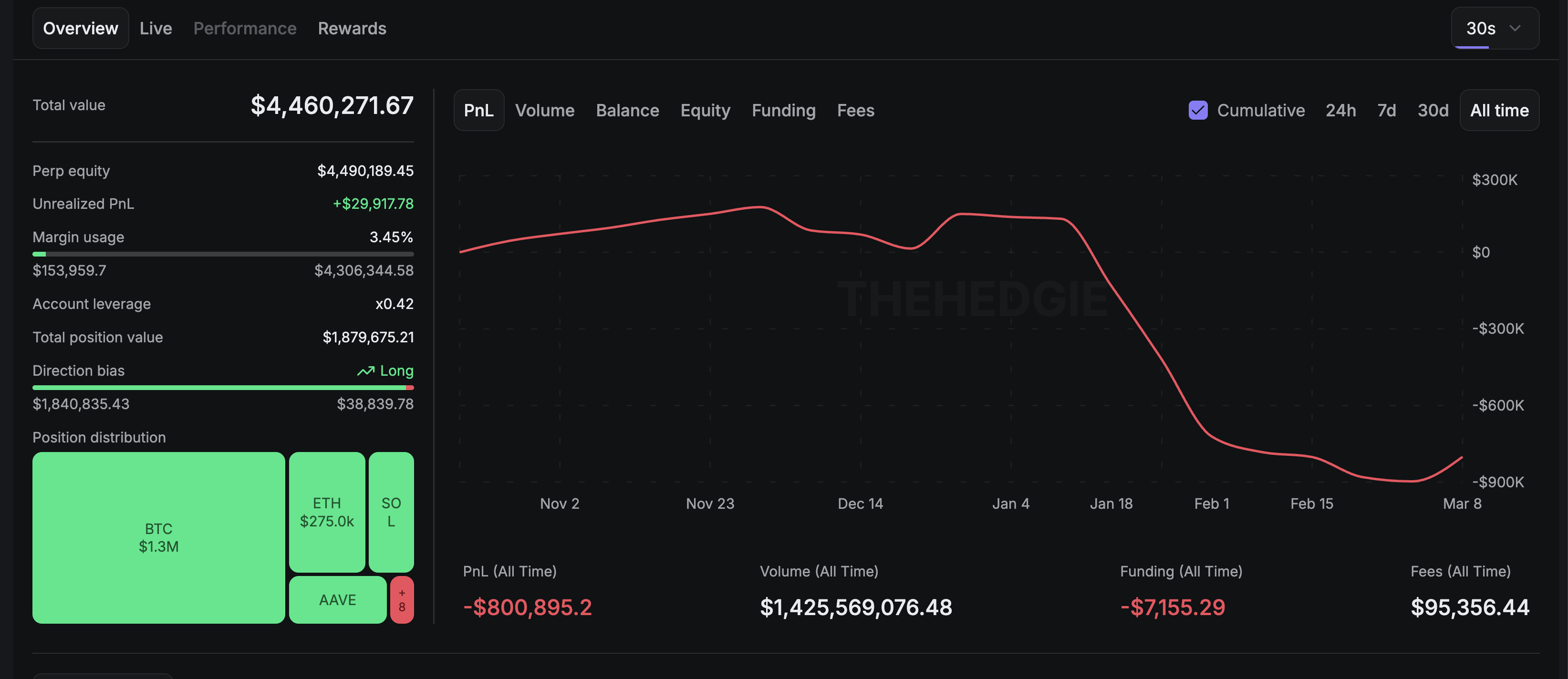
This is Auros, a professional institutional market making firm, on Ethereal. They are profitable on Hyperliquid and other venues, but their Ethereal account tells a different story:
- Account size: $4.46M
- Total volume: $1.4B
- All-time PnL: -$800,895
- Open positions: $1.88M across 12 coins
- BTC position alone: 69.68 BTC long ($1.25M cost), -$657K realized losses
They peaked at +$300K in November, then drew down to -$900K by March 2026. A professional firm with millions in capital and billions in volume, still net negative on this venue.
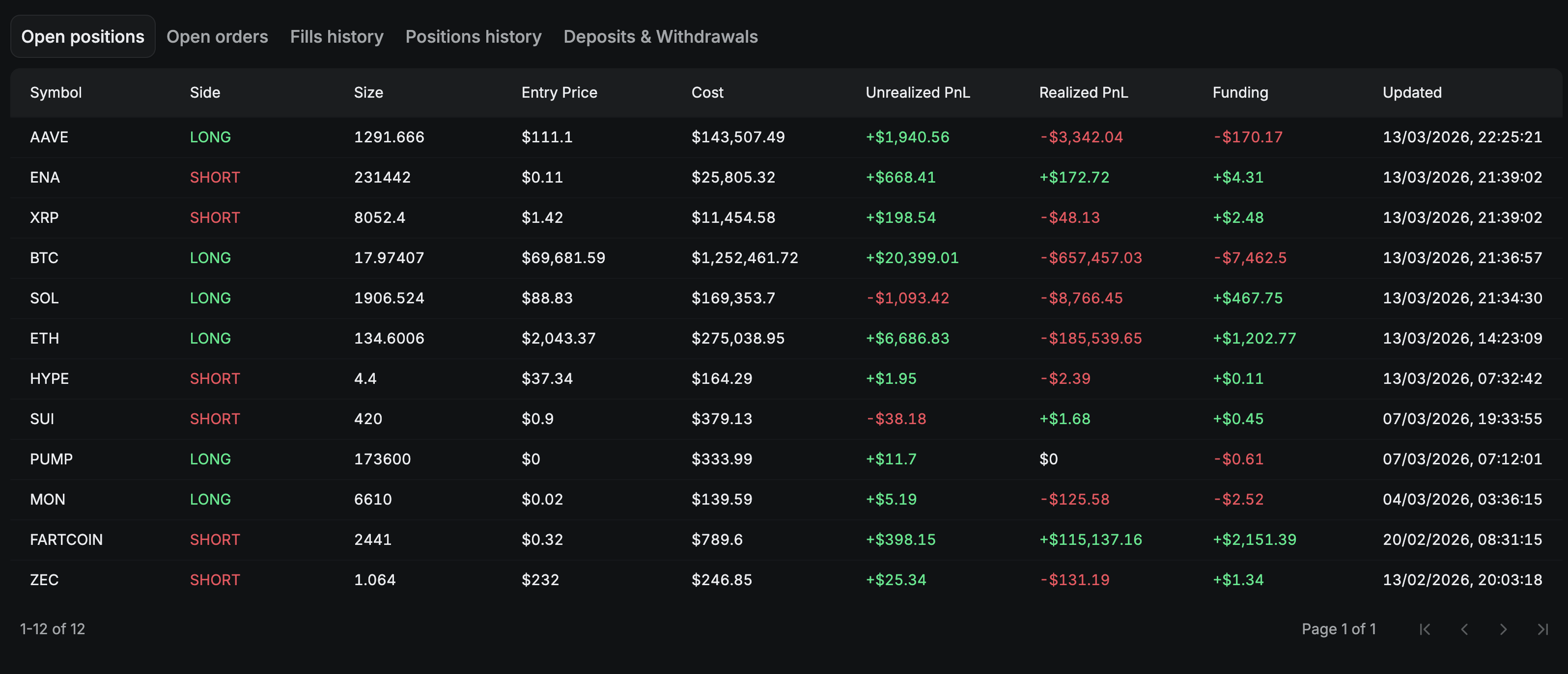
But Auros is also profitable on multiple positions. Drawdowns are temporary — if you can hold through the bad, time it properly, and manage your risk, market making can also produce significant returns:

What this shows:
- Market making is not guaranteed profit — even professionals with millions lose money
- But drawdowns are not permanent — the same firm is also up significantly on other positions
- Volume does not equal profitability — $1.4B traded, still down $800K on the venue overall
- Different venues have different dynamics — being profitable on one doesn't guarantee profitability on another
Trading losses on these DEXs can also be offset by future airdrop gains. Many protocols reward liquidity providers with token airdrops, and the volume you generate while market making accrues points toward those distributions. Some traders who are net negative on PnL end up net positive when airdrop allocations are factored in.
Pro Trader — Higher Returns, Higher Risk
The most profitable strategy on the platform is the Pro Trader (HFT scalper), but it comes with a critical tradeoff: it requires substantial capital and active management.
Pro Trader takes directional positions based on real-time signals. When it's right, it compounds fast. When it's wrong, losses can escalate quickly if you're not watching. Unlike the Ladder Bot which stays near-flat by design, Pro Trader can build large positions in one direction.
This is not a set-and-forget strategy. You need to understand what it's doing, monitor it regularly, and be prepared to intervene. If you let it run unsupervised with high leverage, you can lose your entire account.
Realistic Expectations
Ladder bots make money by capturing small spreads many times. A typical profitable day earns 0.1-0.5% on your capital. A bad day might lose 1-3%.
This is not a guaranteed profit machine. Some days, some weeks, you will lose money. The bot's edge comes from being systematic over hundreds or thousands of trades — not from any single trade.
What normal looks like:
- Most fills are small profits (a few bps each)
- Occasional larger losses when price trends against you
- Overall positive expectancy over time with proper settings
- Periodic drawdowns of 5-15% of capital are normal during high volatility
What goes wrong:
- Leverage too high + volatile market = liquidation
- Max inventory set too high = position grows beyond what your account can handle
- Spread too tight on an illiquid pair = adverse selection (you get picked off by informed traders)
- Running during major news events without monitoring
The Bottom Line
Market making is not zero sum. It's about understanding your risk, taking calculated trades, and accepting that losses are as possible as gains. Trading is about probabilities — over hundreds or thousands of trades, a small edge compounds into real returns. But that edge requires discipline.
Do not oversize your position. Do not think you can turn it on and forget about it. There is nothing in the world — no algorithm, no bot, no strategy — that you can just turn on and walk away from forever. Every market maker, from a solo trader with $500 to a professional firm with $4.5M, has to manage their risk actively.
Rules of thumb:
- Start with 1x-3x leverage. You can always increase later once you understand your bot's behavior.
- Set max inventory to 2-3x your budget. This is the single most important risk parameter.
- Use Mode 3 with geometric sizing and inventory skew ON. These are the developer's production settings.
- Monitor for the first few hours. Watch how the bot behaves in current market conditions before walking away.
- Don't use your entire account balance. Keep reserve capital for drawdowns. If your exchange balance is $1,000, run a $300-500 budget.